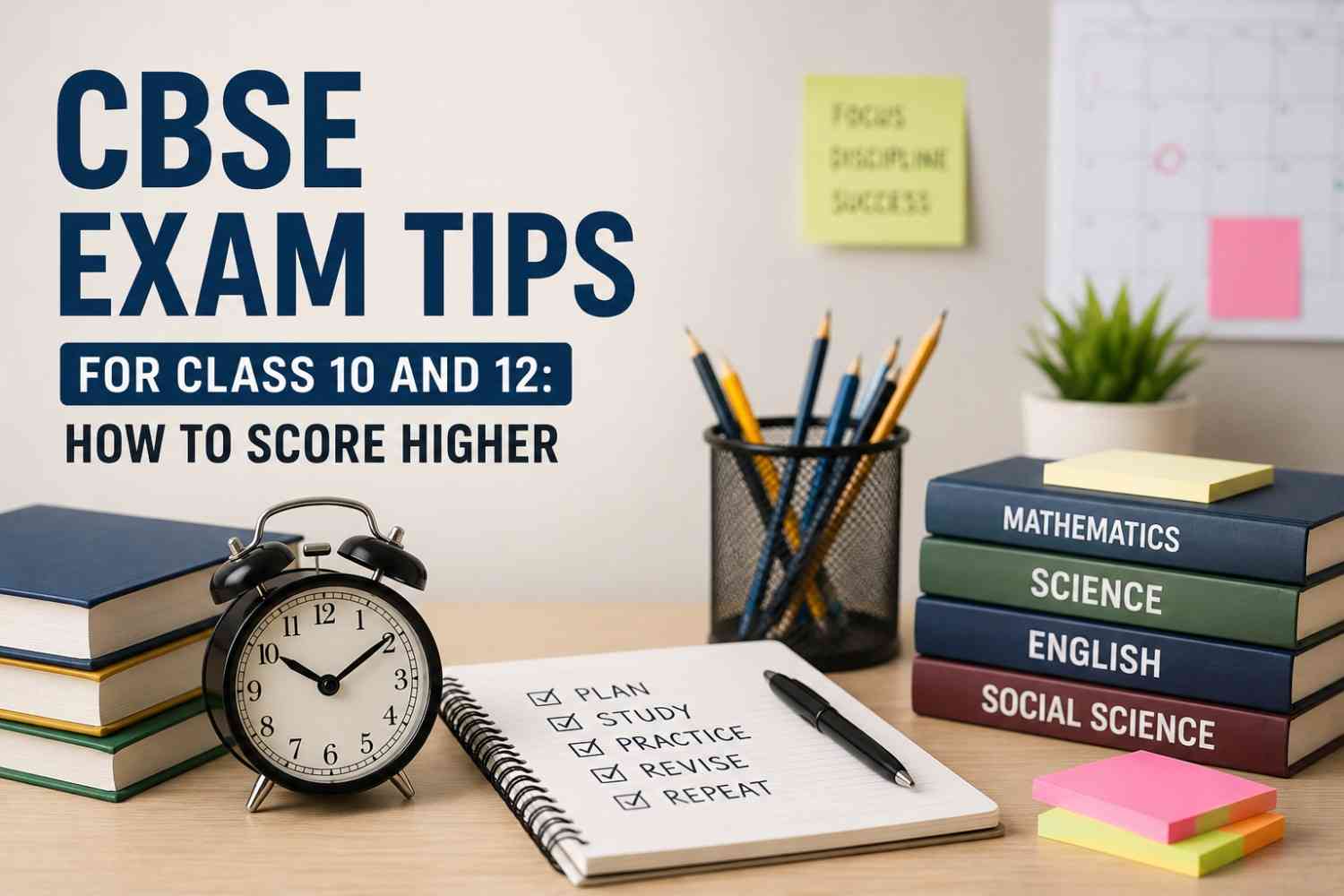
Scoring well in CBSE board exams is not just about studying for long hours. Students need a clear plan, strong conceptual understanding, regular revision, and enough practice to perform confidently in the examination. Whether you are in Class 10 or Class 12, the right preparation strategy can help you use your study time more effectively and avoid unnecessary exam stress.
CBSE has released the curriculum for the 2026–27 academic session for Classes IX–XII, so students should always prepare according to the latest official syllabus and subject requirements.
Why Smart Preparation Matters for CBSE Board Exams
Effective preparation begins with knowing what to study, how to study, and when to revise. Instead of trying to complete everything at the last moment, divide the syllabus into smaller targets and track your progress.
One of the most useful CBSE exam tips is to focus on consistency. Studying a manageable amount every day is generally more effective than depending on long study sessions just before examinations.
Understand the Syllabus and Exam Pattern
Start by reviewing the latest syllabus for every subject. Identify chapters, concepts, practical components, and areas that require more practice. CBSE's curriculum and official academic resources should be your primary reference points.
Set Realistic Study Goals
Create daily and weekly goals instead of simply writing “study Mathematics” or “revise Science.” Set specific targets such as completing a chapter, solving a set of questions, or revising particular concepts.
7 Effective CBSE Exam Tips to Improve Your Score
1. Make NCERT Your Strong Foundation
For most CBSE subjects, students should thoroughly study the prescribed textbooks and understand concepts before moving to additional resources. Read chapters carefully, work through examples, and practise questions instead of relying only on memorisation.
2. Create a Study Schedule You Can Follow
Prepare a timetable that balances difficult subjects, easier subjects, revision, and practice. Keep your most challenging topics for the time of day when you can concentrate best.
A practical schedule should include:
Concept learning
Question practice
Revision
Mock-test practice
Short breaks
This is among the most practical CBSE board exam preparation tips because it gives your preparation a clear direction.
3. Practise Previous-Year Questions
Working through past year questions helps you get a feel for how the same idea can be probed in various ways, kinda in a sneaky different form. After you finish a paper, don’t just look at your marks. Go back, spot the wrong answers and then figure out what actually happened: was it a gap in knowledge, a misunderstanding of the concept, a calculation slip, or just careless reading?
4. Use Sample Papers as a Performance Test
Sample papers can help students become familiar with question-paper design and practise completing questions within a fixed time. CBSE provides Sample Question Papers and marking schemes as guidance for Classes X and XII.
Treat every mock test as a diagnostic exercise. Record your mistakes and revise those topics before attempting another paper.
5. Revise Using Short Notes and Active Recall
Don't wait until the entire syllabus is finished before revising. Prepare concise notes containing formulas, definitions, important concepts, diagrams, dates, and difficult points.
After studying a topic, close your book and try to recall the key points yourself. This makes revision more active and helps identify gaps in understanding.
6. Improve Answer Writing and Presentation
Knowing an answer is only one part of scoring well. Students should also practise presenting answers clearly.
Depending on the subject, use:
Appropriate headings
Relevant keywords
Step-by-step solutions
Diagrams or flowcharts where useful
Proper calculations and units
Clear and legible presentation
Following these CBSE study tips for students can help you become more confident while answering different types of questions.
7. Give Extra Attention to Weak Topics
Don't spend all your study time revising subjects you already understand. Maintain a list of difficult chapters and revisit them regularly.
A simple approach is learn → practise → test → identify mistakes → revise. This creates a continuous improvement cycle throughout your preparation.
Class 10 and Class 12: Follow the Right Preparation Strategy
Although many CBSE exam tips apply to both classes, students should also understand their different preparation requirements.
CBSE Exam Tips for Class 10 Students
Class 10 students really need to put attention to building solid fundamentals in every subject, not just one. Finish the syllabus in a nice, orderly way, so there is time left. Then practise multiple kinds of question formats, and keep revising the bits that feel weaker or fuzzy. Also work on good answer writing habits early, so by the board exams you are more confident and ready.
CBSE Exam Tips for Class 12 Students
For Class 12 students it really helps to pay a bit more attention to subject specific concepts, and also to practice in a way that actually applies them. Try to solve numerical problems or analytical questions regularly where it fits, not only read the theory. Keep a structured revision plan in place, but also make sure you don’t forget to balance your academics with your future career goals, because both matter kind of equally.
How to Score High in CBSE Board Exams During the Final Month
The final month should focus primarily on revision, practice, and correcting mistakes rather than trying to learn the entire syllabus again.
Follow this approach:
Revise important concepts and notes.
Solve timed sample or previous-year papers.
Review mistakes after every test.
Revisit weak chapters.
Practise formulas, diagrams, definitions, and key points.
Following a consistent CBSE board exam strategy during the final stage can make preparation more organised and reduce last-minute pressure.
Exam-Day Tips to Avoid Losing Easy Marks
Read the instructions and the questions carefully before you start. Try to plan your time based on the paper and don’t spend too long on a difficult question. Make sure your answers are kept in order and leave a little time at the end to check your calculations, any unanswered questions, and those other errors that are pretty easy to avoid.
Good preparation combined with calm execution is an important part of learning how to score high in CBSE board exams.
Common Mistakes Students Should Avoid
Avoid these mistakes during board preparation:
Studying without a realistic timetable
Depending entirely on memorisation
Ignoring weak subjects
Skipping regular revision
Solving mock papers without analysing mistakes
Starting major topics at the last minute
Reducing sleep excessively to increase study hours
Students who are looking for a more structured sort of academic guidance can also check out CBSE Coaching Classes in Pitampura, for a focused board-preparation sort of plan. And if you want 11th 12th Coaching in North Delhi, that's more like the senior secondary support most learners need, without the usual extra confusion.
Final Thoughts
The best CBSE exam tips are usually about studying with a purpose, not just piling on more study hours. First glance at the syllabus, then try to build strong concepts, because that helps later on. Practise regularly, not only at the end. Also, revise in a smart way, and when mistakes happen, use them as a guide. With consistency and the right kind of CBSE exam preparation for Class 10 and 12, students can face their board exams with more confidence and, hopefully, work towards better scores.